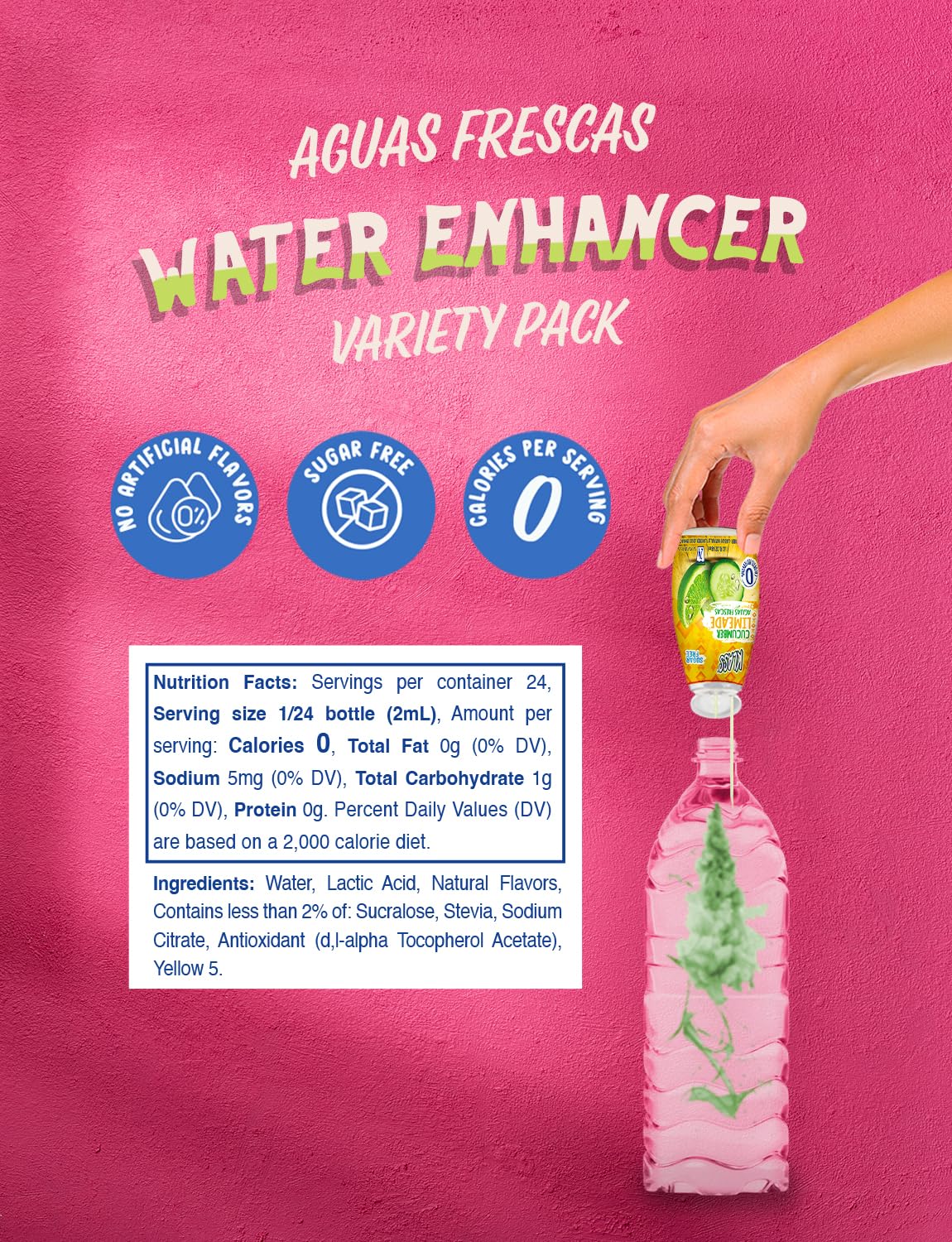
If you’ve ever had a tall glass of agua fresca at a taqueria — that lightly sweetened, vibrantly colored drink made from blended fruit, water, and a touch of sugar — you already understand the appeal of this product category. An agua fresca is essentially Mexico and Central America’s original water enhancer: flavor-forward, refreshing, and simple. The bottled category tries to replicate that experience in a concentrated liquid or powder you add to plain water at home. Most mainstream water enhancers (think MiO or Crystal Light) reach for generic berry or citrus profiles. A smaller, fast-growing corner of the market leans into the actual flavor vocabulary of Latin agua fresca culture — tamarind, hibiscus (jamaica), horchata (the rice-and-cinnamon drink), cucumber-lime, and guava. This article maps that corner specifically: what the standout brands are, how their ingredient choices play out in practice, and which one belongs in your rotation depending on what you’re actually optimizing for.
What “Agua Fresca Style” Actually Means on a Product Label
Before we compare brands, it’s worth pinning down what separates a genuine agua fresca–inspired formula from a generic tropical enhancer with a Spanish name on the label.
Authentic agua fresca flavor profiles share a few characteristics: they tend toward lightly tart or floral rather than candy-sweet, they often carry a subtle earthy or herbal undertone (especially tamarind and hibiscus), and the sweetness reads as a complement to the fruit rather than the main event. When a packaged product nails this, it tastes like the drink you remember. When it doesn’t, it tastes like a standard “tropical punch” with a different name.
The brands that come closest to the real thing share a few formulation tendencies:
- Hibiscus (jamaica) forward rather than artificial punch flavors
- Real or natural flavor extracts instead of purely synthetic flavor compounds
- Restrained sweetness — either low-added-sugar, lightly sweetened with cane sugar, or sweetened with stevia/monk fruit at a level that doesn’t dominate
That’s the lens we’re applying across Klass, Stur, and the supporting cast below.
Klass: The Authentic Benchmark
Klass is a Mexican brand with genuine roots in the aguas frescas and agua de sabores tradition — it’s been a pantry staple in Latin American households long before “water enhancer” was a U.S. retail category. The product line comes primarily as a powdered drink mix (sold in small single-serve stick packets and larger canisters), not a liquid concentrate like MiO.
What it gets right: Klass’s flavor lineup is the most culturally specific of any mass-market brand in the category. Hibiscus, tamarind, horchata, guava, and passion fruit appear alongside more familiar flavors like strawberry and watermelon. The tamarind SKU in particular draws consistent praise from reviewers who grew up with the drink — the tartness and slight funkiness are present in a way that generic “tropical” flavors never achieve. USDA FoodData Central entries for Klass Agua Fresca products show roughly 60–80 calories per 8 oz serving in the sweetened versions, with sugar derived from cane sugar, not high-fructose corn syrup.
The tradeoff: Klass’s traditional formulations use cane sugar as the primary sweetener — this is not a low-calorie product, and it’s not marketed as one. If your reader is tracking grams of added sugar, the original Klass line doesn’t compete with Stur or other low-calorie options. Some SKUs in their newer “Lite” line do include sucralose, which brings calories down but introduces the standard debate about artificial sweeteners.
Who it’s for: Flavor-first buyers, households where agua fresca authenticity matters, anyone trying to get family members (especially adults who grew up drinking the real thing) off sugary sodas and onto flavored water. The cost-per-serving math is favorable — a canister typically runs $4–$6 and yields 8–10 quarts, putting it well under $0.10 per 8 oz serving by most current retail pricing.
Stur: The Clean-Label Contender with Latin-Friendly Flavors
Stur occupies a different position: it’s a U.S.-born liquid water enhancer (similar format to MiO — a small squeeze bottle you drop into water) that competes hard on the clean-label axis. Its sweetener is stevia leaf extract, and the brand prominently avoids artificial dyes, a relevant call-out as several major competitors remain under scrutiny following California’s 2023 food dye restrictions and the broader national retail shift away from Red 40 and Yellow 5 that accelerated through 2024–2025.
What it gets right: Stur’s flavor palette includes watermelon, cucumber-mint, coconut water, and strawberry-watermelon — these aren’t all traditional agua fresca flavors, but the brand’s approach to lightness, real fruit-forward profiles, and zero artificial colors puts it in the same sensory neighborhood. Reviewers at Well+Good’s 2025 water enhancer roundup highlight Stur’s cucumber-related SKUs as among the cleanest-tasting zero-calorie options available. Owners across aggregated reviews consistently report that Stur doesn’t carry the bitter stevia aftertaste that plagues some stevia-sweetened products — likely because the brand uses a refined stevia extract at a controlled concentration.
The tradeoff: Stur isn’t culturally authentic — it’s not a Latin brand and doesn’t claim to be. If you’re looking for the tamarind or hibiscus complexity that defines authentic agua fresca, Stur’s lineup won’t fully satisfy that brief. It also runs slightly higher in unit cost than Klass: a 1.62 oz Stur bottle covers about 20 servings and retails in the $5–$7 range, putting it at $0.25–$0.35 per serving. That’s still affordable, but roughly 3x the per-serving cost of Klass powder.
Who it’s for: Health-conscious shoppers who want the agua fresca aesthetic — light, fruit-forward, refreshing — in a zero-calorie, clean-label format. Also a strong recommendation for parents looking for an additive-free option for active kids; the American Academy of Pediatrics’ 2023 Healthy Beverages for Children guidance is clear that minimizing artificial dyes and added sugars is the right directional call, and Stur fits both criteria cleanly.
The Supporting Cast: Three More Brands Worth Knowing
The Klass/Stur comparison covers the two clearest market leaders in this flavor territory, but practitioners recommending products to clients — or buyers who’ve cycled through both — should have a few more names loaded.
Jarritos Agua Fresca Drops (launched 2024): Jarritos, the Mexican soda brand, entered the water enhancer space with a concentrated liquid line leaning heavily on its existing flavor equity — mandarin, tamarind, guava, lime. Early reviewer sentiment notes that the tamarind drop is notably more authentic than any competitor in the liquid-concentrate format. Formulated with natural flavors and a cane sugar/stevia hybrid sweetener, it lands at roughly 10 calories per serving. Still building distribution as of mid-2026, but worth tracking.
True Lemon / True Lime (crystallized citrus line): Not positioned as agua fresca, but the cucumber-limeade and watermelon-lime SKUs in True Lemon’s lineup occupy the same functional niche for buyers who want minimal ingredients. Each packet is literally crystallized real citrus/cucumber — the ingredient list is remarkably short. Mintel’s 2025 U.S. Flavored Water and Enhancers Report identifies crystallized natural flavor formats as one of the faster-growing sub-segments, driven precisely by consumers who distrust long ingredient lists.
Clamato Preparado Drops (regional/specialty): A niche call for buyers who want to serve the michelada or agua de clamato flavor profile in a non-alcoholic context. Not a mainstream recommendation, but knowing it exists makes you more useful to clients with specific cultural flavor targets.
By the Numbers: Flavor-First Enhancers at a Glance
| Brand | Format | Sweetener | Calories/serving | Approx. cost/serving | Authentic agua fresca flavors |
|---|---|---|---|---|---|
| Klass (original) | Powder | Cane sugar | 60–80 | ~$0.08–$0.10 | Yes (tamarind, hibiscus, horchata) |
| Klass Lite | Powder | Sucralose blend | 5–10 | ~$0.08–$0.10 | Yes |
| Stur | Liquid drops | Stevia | 0 | ~$0.25–$0.35 | Partial (watermelon, cucumber) |
| Jarritos Drops | Liquid drops | Cane sugar/stevia | ~10 | ~$0.30–$0.40 | Yes (tamarind, guava, mandarin) |
| True Lemon/Lime | Crystallized | None | 0–5 | ~$0.20–$0.30 | Partial (lime-adjacent) |
The Ingredient Watchlist: What to Flag Before You Recommend
If you’re a registered dietitian, trainer, or wellness coach building a product shortlist for clients, two ingredient issues are worth naming explicitly in this category.
Artificial dyes: The mainstream powder-drink-mix category has historically relied on Red 40, Yellow 5, and Blue 1 for vivid color. As of 2025–2026, regulatory and retail pressure has pushed several brands to reformulate, but not all. Klass’s traditional line still uses artificial colors in several SKUs — check the current label. Stur and True Lemon are dye-free across the lineup. The International Food Information Council’s 2024 Food and Health Survey found that 52% of consumers surveyed called artificial colors a top-three concern when choosing a packaged beverage — this is not a fringe concern.
Stevia aftertaste tolerance: Stevia is generally well-regarded nutritionally, but the aftertaste is real and polarizing. If you’re recommending a product to a client or family member who’s never had stevia-sweetened beverages, flag this up front. The Stur formulation handles it better than average based on aggregated owner reviews, but no stevia product eliminates the issue entirely for sensitive palates.
Sodium content: Flavor-first water enhancers like these are not electrolyte products. If a client is an endurance athlete who also wants authentic fruit flavor, the right answer is to stack — use an electrolyte product like LMNT or Nuun for the sodium/potassium/magnesium profile, and use a Klass or Stur flavor for taste layering. These categories don’t have to compete.
The Decision Rule
Here’s the clean “if/then” frame for this category:
If authenticity and flavor range are the primary goal — and calorie content is not a barrier — start with Klass original. The per-serving cost is the lowest in the category, the flavor lineup is genuinely distinctive, and nothing else in a mass-market format comes close on tamarind and hibiscus.
If clean-label and zero calories are non-negotiable — and the buyer can live without the most culturally specific flavors — Stur is the right call. Dye-free, stevia-sweetened, and consistently well-reviewed for taste among zero-calorie options.
If you want both authenticity and near-zero calories — watch the Jarritos Drops line as it builds distribution. It’s the only product currently threading that needle, and early signal is positive.
If you’re building a recommendation list for a client who needs both electrolytes and great flavor, don’t try to make one product do both jobs. Pair a precision electrolyte formula with one of the above for flavor — that’s a better outcome than either product alone.
The agua fresca category is genuinely underserved by the mainstream water enhancer market, and that gap is closing fast. Getting fluent in this corner now means you’re ahead of the curve when clients ask — and they will.