If you’ve ever flipped over a sports drink packet and felt vaguely suspicious about the long list of ingredients you can’t pronounce, you’re not alone — and you’re asking exactly the right question. Electrolyte packets are single-serve powder pouches you stir into water to replace the minerals (mainly sodium, potassium, and magnesium) your body loses through sweat. The best ones are genuinely useful tools for hydration. The worst ones are glorified candy with a health halo. What separates them? The ingredient label. Specifically, whether a product contains synthetic dyes — man-made color additives like Red 40, Yellow 5, or Blue 1 — that add zero nutritional value and carry enough regulatory scrutiny that California moved to restrict several of them in 2023. This guide is a full audit of the dye-free electrolyte packet market as of mid-2026: what to look for, what to avoid, which brands actually pass, and how to make the tradeoff decision when two “clean” options don’t look the same on paper.
Why Dyes Are Still in Electrolyte Packets (And Why It’s Getting Harder to Justify)
The honest answer is that dyes are cheap, stable, and make a pale powder dissolve into a vivid, appealing drink. For decades that was a defensible trade. It’s becoming less defensible fast.
The Center for Science in the Public Interest’s report, “Food Dyes: A Rainbow of Risks” (updated 2023), documents the regulatory trajectory clearly: multiple petroleum-derived dyes that are standard in U.S. sports nutrition products are banned or require warning labels in the EU. Red 40, Yellow 5, and Yellow 6 — the most common trio in mainstream electrolyte powders — require a “may have an adverse effect on activity and attention in children” label across the European Union. The FDA’s 2025 announcement that it would phase out Red 40 and five other synthetic dyes from food and supplements accelerated the reformulation wave that was already underway after California’s 2023 actions.
For the performance-and-wellness buyer making a deliberate decision, the practical question isn’t whether dyes are definitively dangerous at typical exposure levels — the science there is legitimately contested. The question is: when two products with equivalent electrolyte profiles exist, why would you choose the one with an unnecessary additive that’s on a regulatory watchlist? Our audit frames the decision on exactly that logic.
What “clean label” actually means here: In this context, a product passes our audit if it contains no synthetic petroleum-derived colorants (Red 40, Yellow 5, Yellow 6, Blue 1, Blue 2, Green 3). Natural colorings derived from fruit and vegetable juice concentrates — beet powder, turmeric, spirulina — are fine. So is no color at all.
The Audit Framework: Four Criteria Beyond “No Dyes”
Eliminating dyes is the floor, not the ceiling. A product can be dye-free and still be poorly formulated. Here’s the full four-factor filter we applied to every brand reviewed:
1. Dye status (binary pass/fail) Any synthetic petroleum-derived colorant = fail. Products using fruit- or vegetable-based color or no color = pass.
2. Sodium content relative to sweat loss The American College of Sports Medicine’s 2023 position stand on exercise and fluid replacement identifies sodium as the primary electrolyte lost in sweat, at roughly 500–1,000 mg per liter of sweat for most athletes. Products delivering fewer than 200 mg sodium per serving are better described as “flavor waters” than electrolyte replacers for exercise contexts. We flag anything below that threshold for high-output users. For casual daily hydration, lower sodium is often appropriate — so we call out both tiers.
3. Sweetener transparency Stevia, monk fruit, and erythritol are the three most common sweeteners in “clean” electrolyte packets. All three are generally recognized as safe by the FDA. The audit flags any product using both a natural AND an artificial sweetener (like sucralose or aspartame) in the same formula — a common greenwashing tell. It also flags undisclosed “natural flavors” listed without specificity when sweetener identity matters to the buyer.
4. Third-party certification NSF Certified for Sport or Informed Sport certification means an independent lab has verified that what’s on the label matches what’s in the packet, and that there are no prohibited substances present. For athletes subject to drug testing — and for any consumer who wants label accuracy guaranteed — this is non-negotiable. We note certification status for every named product.
Brands That Pass the Full Audit
These are the dye-free electrolyte packets that cleared all four criteria as of May 2026, based on published formulas, brand disclosures, and aggregated reviewer reporting. Formulas change; always verify the current label before purchasing.
LMNT (Elemental Labs)
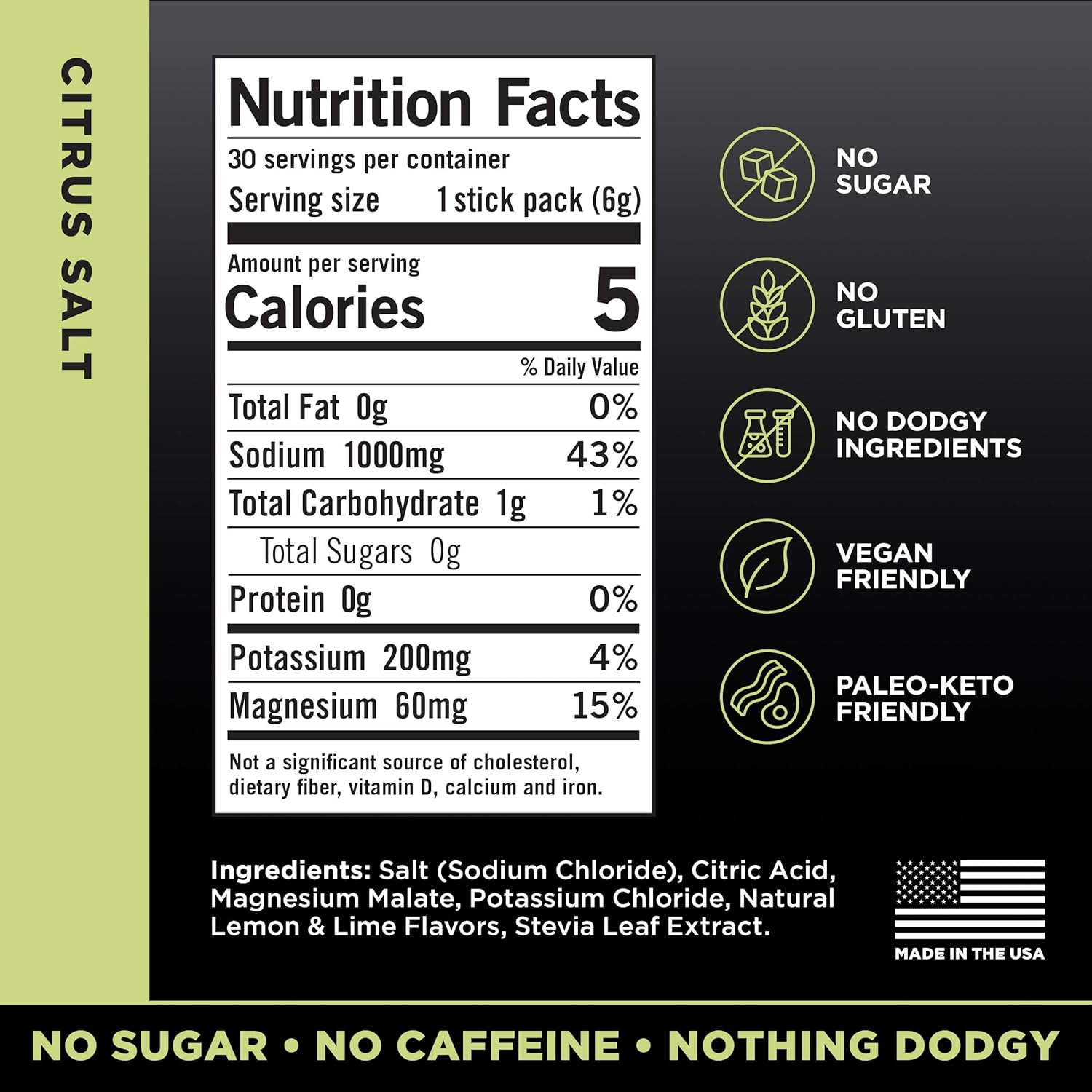
Sodium per packet: 1,000 mg | Sweetener: Stevia | Dyes: None | Certification: None (but full ingredient transparency on all SKUs)
LMNT is the high-sodium benchmark that serious endurance athletes compare everything else against. Its formula — 1,000 mg sodium, 200 mg potassium, 60 mg magnesium — is grounded in the research popularized by sports scientists studying sodium loss in long-duration exercise. The International Journal of Sport Nutrition and Exercise Metabolism’s 2021 review on sodium and fluid balance during exercise supports higher sodium replacement for workouts exceeding 60–90 minutes at moderate-to-high intensity.
The tradeoff: 1,000 mg sodium is aggressive for anyone not sweating heavily. Reviewers who use it for everyday low-activity hydration consistently report it as “too salty” without exercise context. It also lacks NSF or Informed Sport certification. For competitive athletes subject to anti-doping testing, that’s a real gap. For everyone else, the formula transparency is high.
Cure Hydration
Sodium per packet: 260 mg | Sweetener: Coconut sugar | Dyes: None | Certification: None
Cure is the most accessible “clean” option for the mid-tier buyer. It uses organic coconut sugar as its sweetener and carbohydrate source, which places it closer to the oral rehydration solution (ORS) model — a small amount of glucose alongside sodium to activate the sodium-glucose cotransport mechanism in the gut, improving fluid absorption. Examine.com’s electrolyte overview (2025) notes this mechanism as clinically validated, originating from WHO oral rehydration therapy research.
The tradeoff: coconut sugar is still sugar. For keto, low-carb, or diabetic-management contexts, that’s a real consideration. Sodium at 260 mg is appropriate for moderate activity and everyday use but won’t replace sweat losses in high-output sessions without multiple packets. Cure sits firmly in the moderate-activity and general-wellness lane.
Hydrant
Sodium per packet: 240–500 mg (varies by SKU) | Sweetener: Stevia | Dyes: None | Certification: None
Hydrant occupies the middle lane between Cure’s mild formula and LMNT’s high-intensity profile. Their “Boost” and “Sport” lines run 500 mg sodium; the everyday “Hydrate” SKU runs 240 mg. All current formulas are dye-free. Reviewers frequently cite Hydrant as the easiest entry point for people transitioning from dye-laden mainstream sports drinks who aren’t yet ready to pay LMNT-tier prices.
The tradeoff: no third-party certification, and the formula variation across SKUs creates a labeling literacy requirement. Buyers need to know which product they’re purchasing and match it to their use case.
Nuun Sport (current dye-free reformulation)
Sodium per packet (tab): 300 mg | Sweetener: Stevia + dextrose | Dyes: None (as of 2025 reformulation) | Certification: Informed Sport ✓
Nuun is the most interesting story in this category right now. The brand spent years under criticism for including artificial sweeteners and, in some SKUs, synthetic dyes. The 2025 reformulation of the Sport line removed all synthetic dyes and transitioned to stevia plus a small amount of dextrose. More importantly, Nuun Sport carries Informed Sport certification — the only widely distributed, mass-retail electrolyte tablet in this guide that does.
The tradeoff: “stevia plus dextrose” means two sweeteners, which sits just at the edge of our sweetener transparency criterion. The dextrose is functional (same glucose-transport rationale as Cure’s coconut sugar), not a greenwashing move, but buyers who want zero-sugar formulas should note it.
Drink LMNT Raw (unflavored)
For users who want zero sweetener, zero flavoring, and zero ambiguity: LMNT’s Raw SKU is plain electrolytes, no additives whatsoever. It passes every audit criterion cleanly by eliminating the categories that create friction.
By the Numbers: Sodium Range Across Audit-Passing Brands
| Brand / SKU | Sodium (mg) | Certified? | Sweetener |
|---|---|---|---|
| LMNT (standard) | 1,000 | No | Stevia |
| LMNT Raw | 1,000 | No | None |
| Hydrant Sport | 500 | No | Stevia |
| Nuun Sport | 300 | Informed Sport ✓ | Stevia + dextrose |
| Cure Hydration | 260 | No | Coconut sugar |
| Hydrant Hydrate | 240 | No | Stevia |
Formulas current as of May 2026. Verify current label before purchase.
The Brands That Don’t Pass (And Why It Matters)
Liquid I.V. (standard formula): Still uses Yellow 5 and Yellow 6 in several SKUs as of Q1 2026, though the brand has publicly committed to reformulation timelines. Do not assume the clean-label version is in the packet you’re currently holding — check the label at point of purchase. The American Academy of Pediatrics’ clinical report on sports and energy drinks specifically flags synthetic dyes as a concern for pediatric use, which matters if you’re a parent buying these for kids.
Powerade Powder and Gatorade Powder: Both still use Red 40, Blue 1, or Yellow 5 depending on flavor. Neither passes the dye criterion. Both fail for performance-focused buyers on other grounds (lower sodium-to-carbohydrate ratios, artificial sweetener combinations). These are legacy formulas optimized for mass retail palatability, not label cleanliness.
Many “hydration” private-label and subscription-box brands: The DTC market has a greenwashing problem. Brands that prominently advertise “no artificial flavors” while quietly including Red 40 for color are common. The fix is mechanical: scan the ingredient list for any item ending in a number (Red 40, Yellow 5, Blue 1) regardless of what the front of the packet says.
The Decision Rule
If you want a simple if/then framework for choosing among the brands that pass:
- If you’re an endurance athlete or heavy sweater doing 60+ minutes of output: LMNT standard is the match. The 1,000 mg sodium formula is purpose-built for your sodium loss rate.
- If you’re an athlete subject to drug testing: Nuun Sport is the only audit-passing option with third-party certification at mainstream retail. That Informed Sport stamp is doing real work.
- If you want moderate everyday hydration without high sodium: Cure or Hydrant Hydrate. Cure if you’re okay with a small amount of natural sugar; Hydrant if you want zero sugar with stevia.
- If you want maximum simplicity with zero additives of any kind: LMNT Raw eliminates every variable.
- If you’re recommending to clients with kids: The AAP guidance makes dye-free non-negotiable, and the lower-sodium moderate options (Cure, Hydrant Hydrate, Nuun Sport) are more appropriate for pediatric activity levels than LMNT’s high-sodium profile.
The dye-free electrolyte market in 2026 is genuinely competitive in a way it wasn’t three years ago. The California regulatory pressure and FDA dye-phase-out announcement have accelerated reformulations industry-wide, which means the “clean” segment has real, comparable options at every price tier. The audit above is designed to give you a starting point — but formula verification at purchase is still your responsibility, because reformulations happen in both directions.