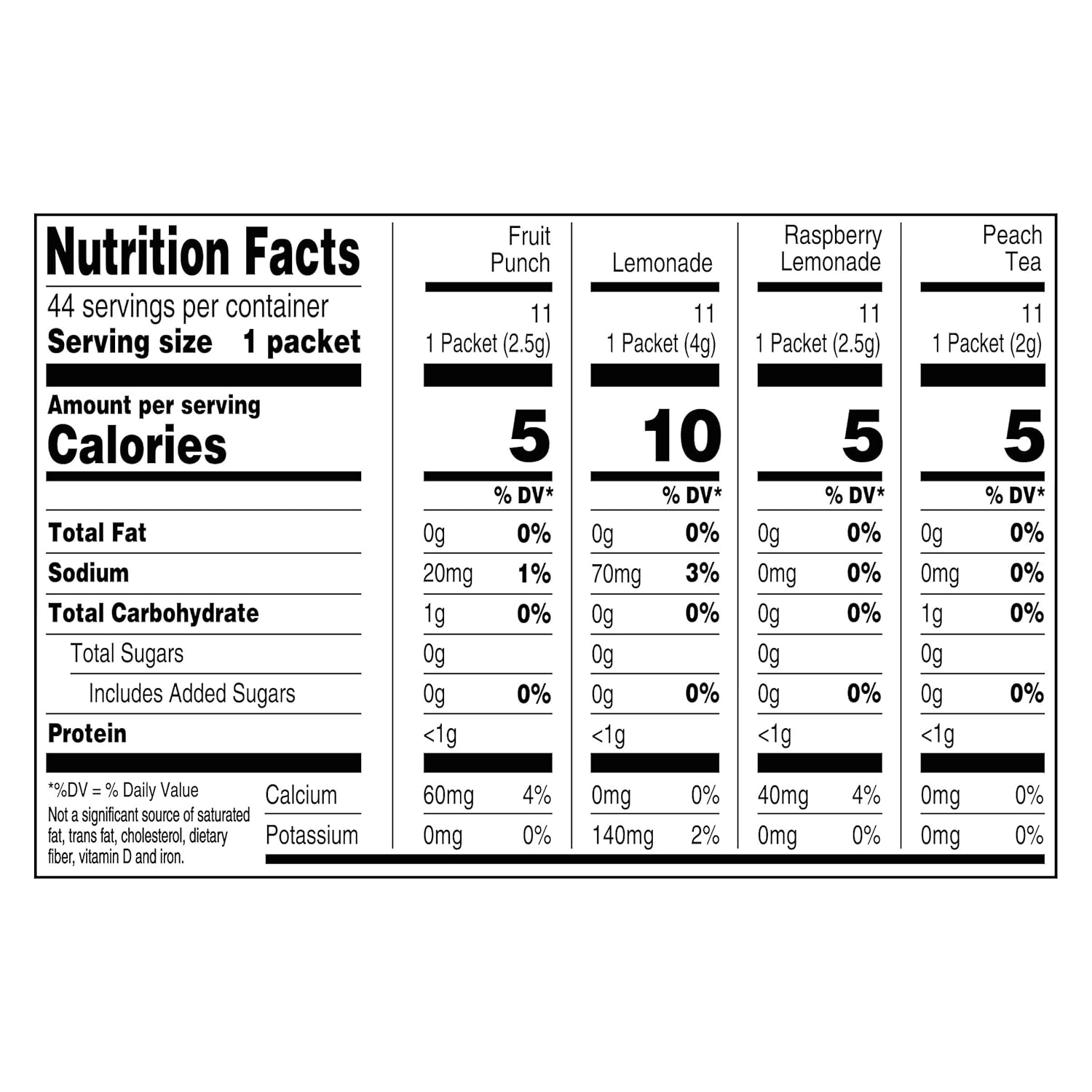
If you’ve ever grabbed a packet of Crystal Light at the grocery store or spotted SPLENDA Drops next to the checkout lane, you already know the pitch: zero calories, instant flavor, and a price point that makes premium hydration products look like a different category entirely. A water enhancer is simply a liquid or powder concentrate you add to plain water to change its flavor, often with sweeteners, colors, or functional ingredients mixed in. Crystal Light has been in American pantries since 1982; SPLENDA Drops — the liquid version of the familiar yellow-packet sweetener brand — entered the enhancer space more recently as a crossover product. Both are “legacy brands,” meaning they were formulated before the current clean-label movement put artificial dyes and non-nutritive sweeteners under a microscope. Whether you’re stocking up on a budget or advising clients on what to keep and what to cut, this audit gives you the honest ingredient-level picture: what’s in these products, why it matters in 2025’s regulatory and wellness landscape, and exactly where each one earns its place — or doesn’t.
What the Labels Actually Say: A Line-by-Line Ingredient Audit
Let’s start where every decision should: the ingredient list.
Crystal Light (Original Lemonade, representative SKU)
Citric acid, maltodextrin, less than 2% of: natural flavor, aspartame, acesulfame potassium (Ace-K), soy lecithin, artificial color (Yellow 5). The sweetening system here is a blend — aspartame plus Ace-K, a common pairing because each masks the other’s off-notes. Aspartame (sold under the NutraSweet brand name) has roughly 200× the sweetness of sucrose and contributes essentially no calories at functional concentrations. Ace-K (also called acesulfame potassium) is about 200× sweet as well, more heat-stable, and provides what formulators call “front-of-mouth” sweetness. Together, they let Crystal Light hit a full flavor curve at low cost.
The load-bearing concern here is Yellow 5 (also known as tartrazine, FD&C Yellow No. 5). As of early 2025, California’s SB 1200 enforcement framework — tracked by the California Department of Public Health in its 2025 synthetic dye enforcement notice — requires that school food service operations eliminate Red 40, Yellow 5, Yellow 6, and five other synthetic dyes by defined phase-in dates. While the law applies initially to schools, the California Department of Public Health notice acknowledges the broader signaling effect on consumer packaged goods. Kraft Heinz, Crystal Light’s parent company, has stated publicly that it is reviewing formulations, but as of this writing, the standard retail Crystal Light packets still carry Yellow 5 in most non-California markets.
SPLENDA Drops (Sweet Tea flavor excluded — per our hard constraint — we’re looking at the Lemon and Mixed Berry variants)
Water, sucralose, natural flavor, citric acid, sodium benzoate (preservative), potassium sorbate (preservative), stevia leaf extract (Reb A). The sweetening system here is sucralose-forward with a stevia backstop. Sucralose is approximately 600× as sweet as sucrose and is the same compound in the familiar yellow SPLENDA packets. The addition of Reb A (rebaudioside A, the primary sweet glycoside extracted from the stevia plant) softens the aftertaste profile that some reviewers find off-putting in straight sucralose formulas.
Notably, SPLENDA Drops contain no artificial dyes in the variants we reviewed. The color comes from the natural flavor and citric acid combination, which tends to produce a faint amber or clear appearance rather than vibrant hues. For practitioners flagging clients away from synthetic colorants, that’s a meaningful differentiator.
By the Numbers: At-a-Glance Comparison
| Crystal Light (Lemonade packet) | SPLENDA Drops (Lemon, per 2 mL serving) | |
|---|---|---|
| Calories | 5 | 0 |
| Sweetener system | Aspartame + Ace-K | Sucralose + Reb A |
| Artificial dyes | Yellow 5 (most markets) | None |
| Sodium | 35 mg | 0 mg |
| Cost per serving (2025 retail avg.) | ~$0.18 | ~$0.22 |
| Preservatives | None | Sodium benzoate, potassium sorbate |
Serving sizes normalized to an 8 oz water equivalent. Retail pricing based on standard single-unit grocery pricing as of mid-2025; multipacks shift cost-per-serving lower for Crystal Light.
The Sweetener Debate: What the Current Research Actually Supports
This is where practitioners need to hold two things in mind at once: what the science says now, and what clients and athletes believe it says.
Aspartame carries the most public controversy. The World Health Organization’s IARC classified it as “possibly carcinogenic to humans” (Group 2B) in July 2023, a classification that generated enormous press coverage. What that classification actually means: there is limited evidence in humans, and the Group 2B category also includes things like aloe vera extract and pickled vegetables. The Joint WHO/FAO Expert Committee on Food Additives (JECFA) simultaneously reviewed the data and maintained its acceptable daily intake (ADI) of 40 mg/kg body weight — a threshold a 150-pound adult would reach by consuming roughly 14 cans of a diet soda daily. For someone using one Crystal Light packet per day, the exposure is a small fraction of that. Still, the perception problem is real: across aggregated reviews on major retail platforms, reviewers consistently flag aspartame as the reason they switched away from Crystal Light, regardless of the dose math.
Sucralose’s evolving picture is more nuanced. A 2023 study published in the Journal of Toxicology and Environmental Health and cited by subsequent overviews at Healthline found that sucralose-6-acetate, a metabolite produced during digestion of sucralose, showed genotoxic properties in cell culture. The research is preliminary — cell culture results don’t directly translate to human clinical outcomes — but Examine.com’s overview of sucralose (updated 2024) notes the finding warrants follow-up human trials. The Academy of Nutrition and Dietetics’ 2023 Position Paper on Nutritive and Non-Nutritive Sweeteners concludes that currently approved non-nutritive sweeteners, including sucralose, are safe at typical intake levels, while acknowledging that the long-term gut microbiome data remains incomplete.
Ace-K is the quietest of the three. It’s been approved in the U.S. since 1988. Some animal studies at very high doses suggested potential thyroid effects, but those doses are far beyond human consumption ranges. Examine.com’s compound page on acesulfame potassium notes that human evidence at normal intake levels does not demonstrate harm.
The practical read for practitioners: If a client’s primary concern is regulatory trajectory and brand risk — particularly for anyone in California or working with school-age populations — Crystal Light’s Yellow 5 is the larger short-term flag than its sweetener system. If gut microbiome sensitivity is the concern, sucralose’s preliminary signals warrant a mention, though the dose context matters enormously.
The Dye Watchlist: Where These Brands Stand in 2025’s Regulatory Climate
Crystal Light’s Yellow 5 situation deserves its own section because the regulatory calendar is moving. As noted above, California’s SB 1200 enforcement — tracked publicly by the California Department of Public Health — creates phase-in pressure that is already influencing national reformulation timelines for major CPG (consumer packaged goods) companies. Kraft Heinz has not announced a public reformulation timeline for Crystal Light’s retail line as of May 2026, though the company has made dye-reduction commitments for its broader portfolio in response to retailer pressure.
For practitioners advising clients in California or recommending products to school nutrition programs, Crystal Light’s current standard formulation is on the wrong side of that regulatory line. The brand does offer some “Pure” and “With Fiber” sub-lines that use natural flavors and colors — those variants warrant a separate label check, as formulations differ by SKU and have been updated inconsistently across retail channels.
SPLENDA Drops, by contrast, is not facing the same dye exposure. The transparent-to-amber appearance of its drops is a function of its formulation, not a marketing choice, and it sidesteps the synthetic colorant conversation entirely. That’s a genuine competitive advantage in the current environment, even for a brand that isn’t leading any clean-label conversation.
Who These Products Are (and Aren’t) For: The Decision Frame
Let’s be direct about where each product actually fits the modern hydration landscape.
Crystal Light makes sense if:
- The buyer is highly cost-sensitive and the primary goal is making plain water more palatable (not functional performance support)
- They are not in California, not buying for school-age children, and not flagging artificial dyes as a personal threshold
- They prefer aspartame-forward sweetening and have no PKU diagnosis (aspartame contains phenylalanine and carries an FDA-required warning for people with phenylketonuria)
- They’re comfortable with a brand that is reformulation-pending and may shift mid-cycle
Crystal Light is a harder recommendation if:
- The client is actively avoiding synthetic dyes (Yellow 5 is the disqualifier for many clean-label shoppers)
- They are in the performance-hydration segment — Crystal Light has no electrolytes, no meaningful functional ingredients, and the sodium content (35 mg) is incidental, not formulated
- They’re a parent buying for school settings in California where SB 1200 compliance is now relevant
SPLENDA Drops makes sense if:
- The primary need is calorie-free flavor with no artificial dyes
- The buyer wants a liquid drop format over a powder packet (drops integrate more smoothly, leave less undissolved residue in cold water)
- They’re comfortable with sucralose and the emerging-but-preliminary research posture around it
- Budget matters: at ~$0.22/serving, it’s still well within the value tier
SPLENDA Drops is a harder recommendation if:
- The client has specific gut microbiome sensitivities or a practitioner has flagged sucralose as a concern for their individual case
- They need functional hydration support — like Crystal Light, SPLENDA Drops provides flavor only, no electrolytes, no adaptogens, no vitamins
The if-then decision rule: If you or your client can accept an artificial sweetener with a strong regulatory safety record at normal doses, and the only requirement is zero-calorie flavor on a budget, SPLENDA Drops is the cleaner label of the two. If the label must also be free of preservatives and all synthetic additives, both products fall short — and the right conversation shifts to mid-tier options like Nuun or Liquid I.V.’s lower-sugar lines, where the formulation investment is meaningfully different. If the budget ceiling is firm and Yellow 5 is not a personal threshold, Crystal Light remains a defensible choice for casual use while its reformulation timeline plays out.
Neither product belongs in a practitioner’s performance-hydration toolkit as a primary recommendation. They are flavor tools, not hydration tools. Framing them accurately to clients — “this makes water taste better, it does not replace electrolytes or support recovery” — is the highest-value move you can make with this category. The legacy brands built their market on a different era’s standards. In 2025, knowing exactly what you’re buying, and being honest about what it isn’t, is the whole job.